Showing posts with label Sean McClellan. Show all posts

Friday, September 26, 2014

[Gamer's Review] Dungeons and Dragons 5th Edition - Part 1


Tiamat, Queen of the Dragons | Image Courtesy of Enworld
I know it's been awhile since I last reviewed a game, so I figured I would do something new with this post- review a table-top role playing game.  Now, for those of you unfamiliar with TTRPGs (which given the nature of this blog and the audience it would attract if it indeed attracted an audience is pretty slim), they are games wherein a group of people, usually ranging from 3-6, come together and use a set of rules to tell a story together.  Each game usually has a Dungeon Master (or Game Master) that works on the general frame of the story and presents challenges to the players, and 2-5 players that creature characters that interact with the world the DM has created.  Together they tell a story, usually one that isn't even remotely close to the one the DM wanted to tell (I'm looking at your RYAN!).

Even those unfamiliar with how a table-top role-playing game works probably still know what Dungeons and Dragons is, or have at least heard of it.  After all, the game has the brand recognition that few others can match.  It's left as much an impact, if not a great impact, in our collective conscious as Pikachu and Mario.

Here we have a Lv 9 Human Monk fighting a Dire Rat blessed by Thor. | Image Courtesy of The Mushroom Kingdom
Now Dungeons and Dragons (or D&D as it is more commonly called), has gone through many different versions, known as editions.  It started out with Gary Gygax and Dave Arneson's original version of Dungeons and Dragons, which was published in 1974, and underwent several changes including Basic Dungeons and Dragons, Advanced Dungeons and Dragons, Advanced Dungeons and Dragons 2nd Edition, Dungeons and Dragons 3.0 (and later 3.5), Dungeons and Dragons 4th Edition, Pathfinder (it's D&D and we all know it), and finally Dungeons and Dragons 5th Edition.  Many other games that were inspired by D&D or designed to play with a similar feel were also created, such as Pelgrane Press' 13th Age.

But now that we're done linking to a bunch of Wikipedia pages, let's get down to business with this article before you all close your browsers and move on to 4chan and Reddit to complain about Gamergate (Ha!  A timely cultural reference from a blogger that only posts once every two years!  That'll sure date this article in three years when it's finally read!).

Alright, seriously, we're going to buckle down now and actually review Dungeons and Dragons 5th Edition.  Now I've been playing D&D since I was sixteen when none other than Cameron Lawrence himself invited me to join his game of D&D (3.5).  One cringe-worthy backstory later and I was Ashiel Dragmire, half-elven sorcerer sent on a quest to recover some hobbit's treasure or something like that.

This?  I'm pretty sure it was this. | Image Courtesy of G4TV.com
Anyway, it only took about five minutes before I was in love.  I spent the ensuring seven years learning everything I could about D&D- the mechanics, the lore, how to optimize my own characters while simultaneously learning how to beat down players who tried to break my games with their own over-powered characters.  I observed Cameron's DM style, as well as the style of our other DM Nate, and tweaked them to create my own way of running games.  As a writer by hobby (and hopefully one day by trade so I can plug articles like this with links to my work), I wasn't worried about telling a story.  I had countless worlds floating around in my head and it wasn't hard to slap some mechanics to them and set my players loose.

Eventually I moved to college and met a new gaming group and picked up on how to play Pathfinder, which wasn't so different than D&D 3.5.  I never got into 4th Edition, mostly because I missed the session that my original gaming group used to test it (they weren't the biggest fans) and my new group's DM had an absolute loathing of it.  I played that for several years before finally joining the Dungeons and Dragons Next playtest.  My buddy Ryan and I created characters (I was, and continue to be, a human rogue while he plays a paladin of Wee Jas) and drove three hours to Scranton, PA for MEPACon, which if you're in the Pennsylvania area I highly recommend going to.  Affordable, some great people there, and all-in-all it's a lot of fun.

YOUNG MAN YOU WILL STOP PLUGGING AND LINKING AND START REVIEWING! | Image Courtesy of Jesus-Is-Savior.com

So Ryan and I had our freshly-rolled characters and a set of rules that at many points seemed very contradictory, but hey, it was a playtest so we understood.  Once we got to playing we found the game to be a little slow and clunky in places.  The DMs at the convention had us take notes about their adventures and the mechanics in general after each 4-hour gaming slot, and when we returned next fall we were given packets with several updates that made for a smoother, more fluid game.  Some old things we liked were taken out, but several newer and better mechanics were added in.  It continued on like this until finally the playtest was closed.  The long wait for the Player's Handbook began...

When the Player's Handbook finally hit the shelves I bought a copy and poured over it.  I was immediately in love.  All the things that I liked from the playtest were there (somethings were nerfed a little more than I liked, but I wasn't about to get all up in arms on the Internet about it.  Wait...) and several new mechanics I wouldn't have even thought of were added in.  At a glance the classes and races appeared rather well-balanced, and several new backgrounds were added in to provide even more options for players.

The Races

 
The Tiefling, a personal favorite of mine and a welcome addition to the PHB | Image Courtesy of Enworld
There are four "core" races in D&D 5e: Dwarves, Elves, Halflings, and Humans.  These represent the four main races that can be found in just about any published Dungeons and Dragons setting without standing out.  Each of the non-human races has at least two sub-race options, allowing players to further customize their character within its race.  For example, a dwarf can either be a hardier hill dwarf, or a stronger mountain dwarf while an elf can either be a magical high elf, wilderness-savvy wood elf, or vile drow.  Humans have the option of using a variant human rule that makes them more akin to 3.X's human race, giving them a free bonus feat and two skill proficiencies at the cost of reduced ability score bonuses.  It's probably the best race option in the game, as feats and skills are immensely powerful and important.

In addition to the four core races there are dragonborn (totally different from the character you've played in Skyrim, gnomes, half-elves, half-orcs, and tieflings.  They are separated from the other four races as they are treated as "unusual" races that may not be present or appropriate for all games and settings.  Due to their more unique natures, these races don't have any sub-race options, at least not in the Player's Handbook.

Overall I was satisfied with the amount of race options in the Player's Handbook.  There were more for me to choose from than in the 3.5 or Pathfinder's Player's Guides, which means I have to do less pleading to get my DM to let me play something uncommon like a tiefling or dragonborn.

The Classes

The Warlock, a unique caster that takes traits from multiple warlock incarnations throughout D&D's history. | Image Courtesy of Enworld
Next up are the classes.  Right away I was impressed with the number of options I had at my disposal.  While there was only one "new" class compared to the PHBs I was used to, it just felt like I had a nearly unlimited number of choices- probably the result of the rather limited choices I was left with in the playtest for this edition.  I could choose anything from the anger-management needing barbarian to the whimsical bard to the wizened cleric to the hippie druid.  I could even be a monk, and more importantly not suck.  Yes, the classes were actually balanced!

Well, mostly.  So far in my time playing 5e as both a player and a Dungeon Master I've found that spellcasting classes are still a little more powerful than non-casting classes, but it's more due to their increased versatility rather than straight damage.  Fighters received a much-needed boost with their Battle Master and Eldritch Knight Specializations, and even monks can use ki to "cast spells."  While basically giving everyone the ability to use magic is a cheap way to balance the game, it is effective and so far I haven't felt as if my character can't contribute to the party, nor as a DM have I seen any one class shine brighter than the rest.

The thing I like most about each class is the option to choose between two or three specializations (clerics and wizards have a larger number of domains or schools to choose from, but the differences are more subtle).  Much like Pathfinder's Archetypes and 3.X's Alternative Class Features, a specialization allows you to narrow your character's focus and give them some cool abilities that not all members of their class might have.  For example, as a rogue you can be a guild thief, an assassin, or an arcane trickster.  As a thief you become more mobile and stealthy, making it easier to sneak up on others and rob them blind as well as survive in dungeons.  Assassins gain the ability to blend in with the crowd and a powerful death attack that allows them to deal even more sneak attack damage (which has been greatly boosted in this edition of Dungeons and Dragons).  Finally, arcane tricksters learn how to cast a few spells and use them in unusual ways to gain an edge in combat.

The specializations aren't quite as balanced as the classes, and it's pretty clear which specializations are superior to others (I'm looking at you Champion.  God you were a disappointment.).  While it's a shame that the same amount of effort wasn't put into the specializations as the classes themselves, I don't think it'll ruin the game in the long-run.  Each class has at least two specializations that are viable.  Hopefully when the Dungeon Master's Guide is released it will come with some new specializations for those classes who don't have as many (*cough cough* sorcerer and barbarian *cough cough*).

The Backgrounds

The Soldier Background, a common choice amongst Fighters, or so I have found. | Image Courtesy of Enworld
While I was originally going to review all of the 5th Edition material I've encountered so far in this article, I'm already at 1,723 words (not including captions!), so I'll wrap up after this section.  Backgrounds were not something I expected from Dungeons and Dragons, but boy am I ever glad to see them!  They're a great tool for new and veteran gamers alike, making it easier for neophyte dungeon delvers to flesh out their characters beyond "I'm a fighter with a sword and I like to kill things, drink ale, collect gold, and make love to beautiful women."
Not that there is anything wrong with that! | Image Courtesy of Collider.com
There are several backgrounds ranging from the Soldier pictured above to the acolyte of the faith to the sly charlatan to the rugged outlander.  Each background provides several proficiencies, either in skills or tools, additional gear that might come in handy in your adventures, and a unique ability that, while rarely provides a mechanical benefit, has a nice role-playing ability or hook.  For instance, a folk hero can more easily find shelter amongst the common people.  There is no mechanical benefit (he doesn't get a +2 to the roll or gain advantage), the DM and the player role-play the encounter between the player's character and the smallfolk whose aid he is trying to gain.

Many of the background also have an alternate background option, such as the guild merchant option for the guild artisan background.  The alternate option might have a slightly different set of proficiencies and different fluff, but it is too similar to the base background to warrant being an independent background choice.  While a nice addition to the playtest's set of backgrounds, I didn't feel as if they brought a whole lot to the table (Hell, I was a guild merchant before it was even a thing!).  Like with the class specializations, I hope that the Dungeons Master's Guide will come with more backgrounds.

I apologize for not getting around to reviewing more of D&D 5e's many, many options, but I feel like I've already used up enough of your time.  Join me next week and we'll look over feats, spells, and the Monster Manual!  Now before I go, I'll leave you with this fantastic video.  This actually happens every time a game of Dungeons and Dragons is played.  Seriously.  Every.  Time.


You can download the Dungeons and Dragons 5th Edition Basic Rules for free here, courtesy of Wizards of the Coast.  Wasn't that nice of them?

Wednesday, November 28, 2012

[Gaming on a Budget] The Kingdom of Loathing, Where an Adventurer is You


Kingdom of Loathing is a turn-based role-playing game created by Asymmetric Publications.  The premise of the game is simple enough: you're an adventurer traveling through the magical Kingdom of Loathing in search of wealth (in this case piles of meat), power, and fame.  How you accomplish this goal depends on which class you select upon character creation.

The six character classes (described on the website as "intoxicating and intoxicated") are the Turtle Tamer, Seal Clubber, Pastamancer, Sauceror, Disco Bandit, and Acordian Thief.  If you haven't realized this already, the Kingdom of Loathing does not take itself very seriously.

As in most RPGs, the Kingdom of Loathing also makes use of an ability score system.  Unlike in most RPGs however, the Kingdom of Loathing's ability scores are not things like "Strength," "Vitality," and "Wisdom," but are instead "Muscle," "Mysticality," and "Moxie."  Increasing the key ability for your class results in gaining levels and unlocking new powers.

I chose to embark upon my adventure as a Seal Clubber, so my experiences with this game will be from that perspective.  After tinkering around with the game for a few minutes to familiarize myself with the controls once more I set out to climb to the Icy Peak of Mt. McLarge Huge.

Image Courtesy of Kingdom of Loathing
The Dangerous Mt. McLargeHuge, home of eXtreme sports enthusiasts, snowman ninjas, and goats alike. | Image Courtesy of Asymmetric Publications

After I climbed to the mist-shrouded peaks of Mt. McLargeHuge I had to fight my way past several frightened yetis that kept knocking me down.  The game assured me that this was quite annoying, and I was unable to disagree.  After getting run over by three yetis, I finally made it to the very top of the mountain where I met the mighty Groar in battle.
Image Courtesy of Kingdom of Loathing
The mighty Groar vs. the (hopefully) mightier Tempestman!  Surely battle for the bards to sing about! | Images Courtesy of Asymmetric Publications
We exchanged blows, I with my mighty Drowsy Sword and he with his claws and frigid breath attacks.  I finally defeated him with my special maneuver (the Seal Clubber's trademark "Thrust-Smack") and harvested his skin like any good animal murderer would do.  With my foe smote in ruin before me Balrog-style, I climbed down the mountain to continue my most noble of quests.

While the description of that battle may have made the battle seem epic and victory difficult to achieve, I assure you that it was not.  All I really had to do was click on a few buttons and the screen and before I knew it the mighty Groar was dead before my feet.

Gameplay

The Kingdom of Loathing uses several different parts to make up its gameplay.  Each character has different abilities, skills, and equipment that determine his or her strengths and weaknesses.  Each day a character can go on 50 Adventures, although there are ways to get more without waiting. Finally there is the combat system itself.

An Adventure is best described as a turn or an action.  Each day you're given 50 Adventures (signified by the hourglass symbol beneath your character), which means you can do about 50 different things before you have to wait until the next day.  Some tasks (such as going on vacation) require more than one Adventure to accomplish.  Eating food and drinking alcohol can replenish a few Adventures each day, but if you drink too much you'll wind up doing something you'll regret (much like in real life!).  If you don't play the game for a few days you'll find that your Adventures accumulate each day until you max out at 200 Adventures.
Image Courtesy of Kingdom of Loathing
The ladies love how muscley I am. | Image Courtesy of Asymmetric Publications
Each character has three abilities: Muscle (your strengthliness and fortitude), Mysticality (your mysteriousness and wizardliness), and Moxie (your chutzpah and roguishness).  Muscle is the primary stat for the Seal Clubber and Turtle Tamer classes and helps determine your total Hit Points.  Mysticality is the primary stat for Pastamancers and Saucerors and determines how many MP you have to use special skills.  Moxie is the main stat for the Accordion Thief and Disco Bandit classes and determines your ability to dodge attacks and how much damage you take from attacks that hit you.  You gain levels in the game by increasing your main stat, which happens over the course of your adventures and from special items.

Finally there's the ever-important combat.  Those of you familiar with the Pokémon Gameboy and Nintendo DS games released by Nintendo (and I'm hoping that people reading a blog about video games have at least a passing knowledge of one of the most successful video game franchises) will find the combat system to be rather familiar.

Since the entire game is more-or-less text-based (I hope you like reading), combat isn't very active.  Once you happen across a monster you're given a few options: "Attack with your [weapon]," "Use Item," and "Use Skill."

The pop-culture references never fail to amuse me. | Image Courtesy of Asymmetric Publications
I've found that as a Seal Clubber most of my problems can be solved with the first option.  Anything that can't be killed with a regular attack from my sword can usually be taken care of with a Thrust-Smack.  Other classes have their own ways of solving disputes, such as the Turtle Tamer's shell auras and the Accordion Thief's songs.

Once you've chosen which method of attack you wish to use, the game will determine how effective it was and then have the monster attack you in return.  This back-and-forth will continue until you're victorious or sent home to lick your wounds.  Should you survive (and the survival rate of most adventurers is actually pretty high), you'll be given your precious loot, which is usually in the form of meat (the game's currency), one or two minor items, and occasionally an important or powerful quest item or weapon.

The game isn't that hard to figure out, although the sheer amount of things you can do and loot you can acquire can be overwhelming at first.  However, once you get used to it, Kingdom of Loathing becomes a great game that can be played for a few minutes in your spare time.  Just don't play it during class or at an important meeting.

Best Pop Culture Reference

The Kingdom of Loathing is chock-full of pop culture references, which really help set the unapologetically sarcastic tone of the game.  So far one of my favorite references in the game is the Meatloaf Helmet, a piece of armor that can be worn to increase your resistance against stench damage (I did mention that this game doesn't take itself too seriously, right?)

Meatloaf Helmet- This is a helmet made of meatloaf.  Mmmmm.  You feel like a Bat out of Hell when you wear it.  You would do anything for this hat (but you won't do that.)

Tuesday, August 28, 2012

[Gaming On a Budget] Slender

After taking another hiatus from my journalistic pursuits (to continue all that romancing and Great American novel writing I told you all so much about in my last post), I've decided to come back and write another article for our "Gaming On a Budget" section.  Since I figure the six-member audience this blog has is comprised mostly of college students, graduate students, and post-college/graduate students, the amount of money in our collective pockets probably isn't enough to buy the latest and greatest video game that just hit the market.  I just want to point out now that I do not consider Madden NFL 13 to be the latest and greatest video game.  Anyway, let's get the meat of the article.

Image Courtesy of Gameranx

Slender is a free game developed by Parsec Productions, an indie game developer, based on the Slender Man meme that has become all the rage on the Internet thanks to games like Slender and the YouTube video series "Marble Hornets."  For those of you who don't know who or what the Slender Man is, allow me to enlighten you.

"Hello children!" "Hey Slender Man!" | Know Your Meme
Slender Man is a tall, gangly (if not well-dressed and somewhat posh and dapper) humanoid with abnormally long arms and a featureless white face.  He can elongate or shorten his arms, and it is rumored that tentacles sprout from his back.  While this might seem scary enough such as it is, Slender Man can also cause memory loss, insomnia, paranoia, and coughing fits in people (much like these popular pills).  He also distorts audio and video, making it almost impossible to catch him on film.

There isn't much of a story line for Slender, you simply appear in the woods at night armed with nothing more than your wits and a flashlight.  The controls aren't very complex.  Moving the mouse allows you to look around, the WASD keys control your movement, holding down Shift lets you run for a brief period of time, the left and right mouse buttons let you pick up pages or turn your flashlight off and on respectively.

The goal is to collect eight pages scattered across the forest before the Slender Man catches you.  It starts off easy enough, with the Slender Man not moving too fast and the forest being pretty easy to navigate

Just like Brittany, Slender Man just wants to be left alone. | Up to Down
As you continue exploring the forest trying to find the different pages you may start to notice some things.  The fog might start to get thicker, making it hard to navigate through the trees.  You'll find that you can't run as long or as fast.  Maybe your flashlight's battery will die, leaving you alone in the dark.  Then you'll start to notice the screen getting fuzzy...

That's your cue to run.  If you're familiar with the Slender Man mythos (or if you read my brief and informative section about the Slender Man about three paragraphs up) you know what that means: Slendy is near.  When that happens holding Shift will allow you to run even faster so that you can try to escape Slender Man, but it comes at the permanent cost of your stamina.  Running from the Slender Man is physically and emotionally taxing and you can only take so much before you finally succumb.

If you're lucky you'll be able to escape from the Slender Man and continue your quest to find the different pages.  However, if you're like me during my second play through you'll notice the visual tearing and run...

He is a very dapper dresser! |  Softonic
... Right into the Slender Man's waiting arms.

I'm not going to tell you what happens if you manage to collect all eight pages.  You can either play the game or go to some other website for that information.  I will, however, recommend that you play the game while sitting alone in your room with all the lights off and as little outside noise as possible.  It really helps set the mood that Slender is aiming for.

I definitely recommend giving Slender a try, especially if you're a fan of psychological horror games.  Nothing else has quite made me jump or scream (if you can call the noise that came out of my fear-distorted face a scream) like Slender.  You can download Slender for free here.

Tuesday, July 10, 2012

[Gaming On a Budget] Strike Force Heroes

It's been awhile since I last sat down and wrote an article.  While I'd love to say it was because I've been spending most of my time working, romancing my girlfriend, writing the next Great American Novel, or spending quality time with friends and family, it's really not.  Not that I haven't been doing that (because I totally have, ask anyone), it's mostly because the semester ended and I was tired of doing anything related to journalism and also because I'm lazy.

Mostly because I'm lazy.

But then today while I was trying to avoid writing with all of my considerable might and willpower I came across a gem of a game: Strike Force Heroes.


Even the loading screen is pure awesome. | Armorgames.com

I saw the game on NotDoppler (the go-to game site of any man worth his salt) and figured any game with "Strike" or "Force" or "Heroes" would be worth trying out.  The fact that "Strike Force Heroes" has all three of these buzz words in its title made not-clicking on the link to play it impossible.

After waiting for the loading screen to finish its business, I was greeted by the title screen.

Which was also pure awesome.  Look at the fire and the bullets and the knife guy! | Armorgames.com
It looks like some 80s arcade game and something for the SNES decided to get drunk and make a boxart baby.  After entering my name I entered the world of Strike Force Heroes.  It turned out that the game isn't so much a strategy game (which I had been hoping for), but was instead a side-scrolling shoot 'em up.

If you've played any of JuiceTin's other games (Raze or Raze 2) or the old and rather popular Unreal Flash game, you already know how to play Strike Force Heroes.  You enter the battlefield, move around with WASD or the arrow keys, and shoot your way to victory.  Simple and incredibly fun.

However, to say that Strike Force Heroes is the same as Raze or Unreal Flash would be a lie.  Following the incredibly popular Battlefield 3's footsteps, Strike Force Heroes (which I will refer to as "SFH" from now on) uses a sort of "class-system."  There are four classes: Medic (Assault), Assassin (Recon), Commando (Support), and Tank (Engineer?).

Each class has its own weapon, skill, and kill streak options.  For example, the Medic class focuses on using assault rifles and similar weapons, machine pistols and submachine guns (which are shared by all classes), kill streaks that focus on supporting and healing allies, and skills that make him harder to kill by restoring his health.  Overall, the medic is pretty well balanced and can be easily played by anyone.

Image courtesy of Armorgames.com
The Commando is sort of like the Heavy from TF2, it runs around with a big gun and shoots things full of holes.  Higher damage and rate of fire than the Medic's assault rifles, but its range and accuracy aren't as good.  I've found that the Commando is the best class to use when I want to rack up the kills.

It's also the best class to use if I want to look like a total bad-ass! | Armorgames.com
The Assassin is the class I'm least familiar with, as I'm a piss-poor sniper in FPS games and my skills in side-scrollers isn't much better.  As one could assume, the assassin is good as using stealth and subterfuge to take out enemies quickly and efficiently.  It uses the standard sniper weapon: the rifle, but if you would rather get up close and personal the assassin can purchase and wield knives in battle as well.  The assassin's skills and kill streaks focus on making it harder to find and pointing out enemies for his allies to take out.

Even when dressed like a Final Fantasy ninja I'm still bad at assassining. | Armorgames.com

The last class is the Tank.  They are good at taking hits and not too shabby at dishing out damage.  The weapon choice available to the Tank is more polarized than those available to the other classes.  Tanks can either use shotguns (close quarter weapons that deal a lot of damage) or shields (deal no damage but when used to block protects the Tank from enemy fire).  I'm currently working with a shield and MP5 submachine gun and it's working out quite well for me.

The fact that I can be an Imperial Stormtrooper makes the Tank class even more appealing. | Armorgames.com
What makes SFH stand out from similar games is the how classes affect the overall gameplay.  In Raze and Raze 2 you get to customize your character, pick a name, and enter the battlefield with a pistol.  You run around shooting people and collecting weapons, ammo, and power-ups.  In SFH you enter the battlefield as whatever class you left up on the Soldier Menu screen (which can be kind of annoying until you get used to it) with the weapons, skill, and kill streak you selected.  Ammo and medipacs can be picked up to help you on your mission, but for the most part you're stuck with what you carried on to the field.

When you die you can pick which class you want to use in your next life.  Each kill nets you experience, which in turn will level you up and unlock new weapons, streaks, and skills.  You also earn money which allows you to purchase the aforementioned things.  Each class tallies its XP and money separately, so the classes you favor will become stronger faster, but it also makes it harder for the other classes to unlock their better weapons and skills.

Image Courtesy of Armorgames.com
The Soldier Menu is pretty easy to navigate and use.  Just click on something and another menu will appear.  Each class's level, money, stats, weapon load out, and skill sets is visible.  The only thing that I found frustrating was the fact that I'd have to click the class I wanted to start the next mission or match with before I left, or I could wind up playing a Medic when what I really needed to use was my Tank.  However, after a few games leaving the menu on the appropriate class became second nature.

I haven't played the campaign much, instead I've been playing Quickplay matches to earn money and XP for my classes.  From what I've gathered though, you play as a member of the Strike Force and you're trying to rescue a scientist or something.  Who knows?  The third level is played on a airplane that's falling out of the sky and being followed by mysterious MiG fighters.  If that's not enough to excite you then you've probably killed your inner child.

Overall SFH is a fun and addicting little game, and is definitely one of JuiceTin's best.  It combines the best parts of side scrolling action games with guns, class-roles, and the kill streak system that has become such a prominent part of shooting games.  I definitely recommend that you give it a try.

For my next article I'd like to review the Skyrim expansion Dawnguard, but since I have a Playstation 3 that currently doesn't work my television and Bethesda and Microsoft are butt-buddies, it might be awhile...

I'm on to you Todd, I know you and Mr. Gates are more than "really good friends."

Wednesday, April 11, 2012

[Gamer's Review] Indie Games: Journey

Journey's Title Screen | Thenerdpocalypse.com

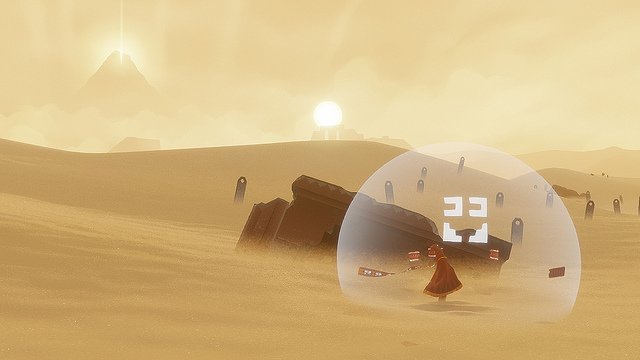
Yesterday I went to GameStop to buy Journey, an Indie game developed by thatgamecompany.  It's a third-person game that I would best describe as a cooperative platformer.  I had first learned about Journey from Penny Arcade and was intrigued by the concept of the game.

Basically you're a robed figure (that looks kind of like a Garo Robe from Majora's Mask) on a journey across a vast desert to a large mountain.  You start this journey alone on the far side of a fairly large hill, and as you climb to the top of the hill and explore the ruins on the other side.  The controls are very simple, the left analogue stick makes you move, "Circle" lets you communicate and interact with the environment through what I can only describe as song.  "X" eventually allows you to jump and glide.  The camera can be manipulated with the right analogue stick or if you have the proper controller, simply by tilted or leaning the controller in one direction or another.

Your intrepid traveler. | MasonicGamer.com

The developers of the game really don't hold your hand much throughout the game, instead forcing you to use things like observation skills and common sense in order to figure out what you're supposed to do.  The only real "tutorials" were when I learned that "Circle" lets me communicate with others and "X" lets me jump and glide.  Everything else you have to learn either through watching the cut scenes or by observing your traveling companion.

Speaking of your companion, you're not alone in your travels across the scorching desert.  Shortly after learning the controls (all three of them), you run into your companion for the rest of the game.  Or at least I did, I have yet to do a second play-through of the game to be absolutely sure.  You aren't told your companion's name and you can't use a headset to talk to him or her.  Rather, you're forced to rely on pantomiming your actions and using "Circle" to get his or her attention so they watch you do something.  It takes some getting used to, but my companion and I figured out how to work with each other shortly after solving the first puzzle.

As it turns out, we were both fluent in "hieroglyph." | Stevivor.com
I did learn at the very end that it is possible to write short messages in the ground, which usually leaves footprints behind for a couple of seconds.  I wrote out "Hello" in barely legible cursive for my companion last night, but I don't think he noticed.  Next time I hope to discuss the socioeconomic status of Poland with a complete stranger.

The game does offer a single player experience, or at the very least you can play without an Internet connection.  I'm not sure how that would work, as there were several times that without my traveling buddy I would have been completely screwed.  You see, there are some puzzles that are easier to solve with two people, and by "singing" you can recharge the runes on your companion's scarf, allowing them to continue jumping and gliding.  Without such a companion, you'd be forced to rely on the environment to recharge the runes, which while possible, would certainly make things more difficult for you.

As you can probably tell from the images throughout this article, the visuals on this game are simplistic, yet I found them to be stunning.  Maybe I'm just an artsy kind of guy (I'm not), but I found myself enthralled by the Wind Waker-esque graphics style (what is that, two Zelda references in this article?).  In a way, the graphics style reminded me of some of the paintings I've seen from the three museum trips I've made during my twenty-year-long life.  I may have visited one of those museums twice.

The game's soundtrack, which seamlessly switches between calming and almost Zen-like to tension-filled and "Oh shit don't let those flying robot snakes find you!", was composed by Austin Wintory, who has composed soundtracks for several Sundance Films and video games, including fl0w, also by thatgamecompany.  The music remains subtle throughout the game, but without it I firmly believe that Journey wouldn't have been nearly as good as it is.

"Are we there yet?" | Thatgamecompany.com
I realize that I've been gushing over this game for the past 641 words (don't believe me?  Count 'em up, I'll wait.), so I'll dive into the critiques and criticisms portion of this article.  The only real beef I have with Journey is the fact that it's so short.  The game only took me two hours or so to complete.  The game play and my overwhelming desire to get to the top of the mountain made that time fly by, so it seemed ever shorter to me.  However, I don't think that the developers could add anything to Journey that wouldn't ruin the game, so it would be best for everyone if they ignored that complaint.

While I understand Journey's an indie game and therefore has a smaller budget at their disposal, it would have been nice if I could have done a little character customization.  Even changing my brown cloak into a nice red would have been enough for me.  It is possible that such a thing would ruin the experience of the game, since it's supposed to be about two strangers helping one another on their mutual quest, but it'd still be nice.

"You go first."  "No man, you go first." | Gamecatalyst.com
 Journey is not a game for everyone.  If all you look for in a video game is awesome graphics, intense game play, and lots of sex and violence, there are other games to spend your money on.  If you like cooperative game play and puzzle solving (something I never thought I'd like), then look in between your couch cushions for $15 in change, because that's all that Journey will cost you.

All in all, I loved this game.  If I had to assign an arbitrary number to Journey (say, between 1 and 10), I'd give it a 9.  If you have $15 and two hours of free time, I definitely recommend that you give Journey a chance.

Monday, April 9, 2012

[Top 5] Games That Deserve Sequels and/or Remakes

Sorry for being about two weeks late with this latest Friday update.  I've had a lot on my plate in college land.  Hopefully this little article will appease you and get rid of any hard feelings.  No?  Oh well, I'll post it anyway.

Normally sequels and remakes are an atrocity and the people behind them deserve to be drug out into the street and shot.  Sequels suck and are made to cash in on a previous success without requiring much thought or effort.  The only constant exceptions are planned sequels, trilogies, and series.

On the same note, most remakes are just “get rich quick” schemes that take classic games, update the graphics, maybe throw in some extra features like expanded multiplayer, an extra weapon, new costumes, or a super cool and horribly overpowered weapon.

However, there are some games that truly deserve a sequel or a remake, and I plan on bringing some of those games to light.  If you disagree with me then go ahead and let me know in the comments section.  If it turns out that such a game has already been made, also inform me of this so I can go out and buy it.


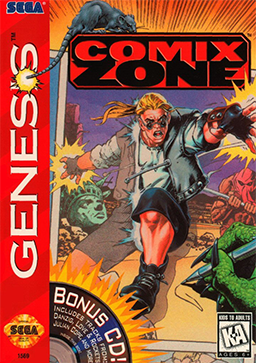
5. Comix Zone
Comics, action, sunglasses, and ponytails.  Comix Zone is truly a representative of the '90s.
Comix Zone is an older game from 90s that proves that you don't need a sensible or plausible story line in order to make sense.  In fact, most games seem to follow that line of thought, so maybe it's better if you just ignore what I wrote.

I don't remember much of Comix Zone, aside from the fact that I was a kick-ass comic book artist that was dragged into a comic by its main villain.  Once inside, I proceeded to kick ass and take names until I got to this one pit I could never get across.  Ever.

Seriously, I spent about 80% of the time playing that game at the freaking pit where I would constantly die because I couldn't jump far enough.  I don't even think I managed to make it out of the first Episode, that's how hard the game was, or how bad I was.  Given that I was only 7 or 8 when I played Comix Zone, it wouldn't surprise me if I was just bad at video games.

Sega, or whoever controls this game now, please revisit this gem.  I know that it can be downloaded on Steam, but you can do better.  Toss in some more episodes or extra endings or improve the game play through more combos (although that might bring it too far into the fighting genre).

Or maybe release Comix Zone 2 where Sketch has to go back into his comics for some reason and kick the ass of an ever stronger villain than Mortus.  You know what?  A sequel sounds a lot better than a remake.  Make a sequel!


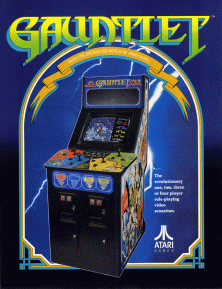
4. Gauntlet
From the Golden Age of gaming where you still had to go outside to play.
When I heard that "Gauntlet" was going to be released for the Nintendo DS I just about shit myself in sheer joy.  I'd be able to play one of the classic dungeon crawl games with friends (because when I little I didn't have friends, clearly) and better graphics.

Then Eidos Studios delayed the game's release.  Then they delayed it again.  Now, four years after its "initial release," Gauntlet DS hasn't hit the shelves and in all likelihood has been cancelled.  My hopes and dreams were crushed, and I would never be able to play Gauntlet with my friends.

Me when I'm old and still haven't played Gauntlet with my friends.
Eidos Studios or Backbone or whoever owns the rights to the game, just release it already.  Everything I read made it sound like you almost finished the game anyway.  If you don't feel like doing that, then hopefully someone else will.

All I really want is some classic hack'n'slash dungeon crawling game that I can play with 1-4 people on a Friday night when all of the cool kids are out drinking and talking to the ladies, is that too much?  I'll even take the smart-ass narrator that loves to remind me over and over again that "The wizard needs food badly!"

I AM AWARE THAT I'M HUNGRY, THANK YOU!


3. Final Fantasy Tactics Advance and Final Fantasy Tactics Advance 2: Grimoire of the Rift
Dear Square Enix, please give me the hundreds of hours I spent playing your games back.

The Final Fantasy Tactics Advance series did two good things for me: introduced me to small-army tactics games (as opposed to Advanced Wars, which is all about amassing a relatively large force), and get me into the Final Fantasy series (although the only other Final Fantasy game I ended up playing was FF3).

The games were beautifully designed, the combat was solid, and the storylines were pretty good.  As a brief recap, in FFTA you were Marche, a kid growing up in the town of St. Ivalice that suddenly found himself in the magical kingdom of Ivalice.  Marche’s goal is to return home with his friends and younger brother, most of whom do not wish to return to their hum drum lives (would you?).  Eventually he convinces everyone that living in Ivalice is a form of escapism and that it’s not healthy to run away from your problems all the time.  End Story, roll credits, applause.  Was Marche the hero, or was he a villain?  FFTA left quite a few unanswered questions.
FFTA2 has a much more upbeat storyline and a happier character: Luso Clemens.  Luso also lives in St. Ivalice with his worrisome aunt.  One day after school, Luso has to serve detention by cleaning up the library.  He finds an old book and is transported to Ivalice (apparently the real one this time).  Unlike Marche, Luso has no intentions of returning home, he’s going to explore and generally have a good time.  However, as fate would have it, Luso needs to step up to the plate and prevent the big bad evil lady Illua from destroying or rewriting the world in her own image (it’s been awhile, okay?).  In the end Luso succeeds, we end the story, roll the credits, and applaud.

Now to the main part of this entry: I want to see Final Fantasy Tactics Advance 3.  The Nintendo 3DS came out not too long ago, so the fine people at Square Enix should be falling all over themselves at the chance to call it Final Fantasy Tactics Advance 3DS: Talisman of the Ancients or something like that.

However, I don’t want the same old “boy finds book, boy is transported to Ivalice” story.  I want a girl to find the book (it’s 2012, we can have female protagonists now), but I want the main character to be a native of Ivalice, not someone from our world.  Make the story about him trying to help the girl, who’s scared and alone in this world, get back home.

Basically, I want this.


2. EA Games’ The Lord of the Ring Trilogy

The Lord of the Rings is probably the best-known modern fantasy series out there.  No, forget I said that.  It is the best known modern fantasy series out there.  Without J.R.R. Tolkien’s works, we wouldn’t have modern fantasy.  There would be no Dungeons and Dragons, which in turn means that the fantasy video games based off of D&D (note: all of them) wouldn’t exist.  Tolkien made it possible to like elves, dwarves, dragons, and hobbits.  Then almost 50 years later Peter Jackson came along and made it cool to like elves, dwarves, dragons, and hobbits!

EA Games took The Lord of the Rings movie trilogy and turned them into three fairly successful games that I quite enjoyed.  It doesn’t get much better than being an elf archer bringing down mumakil and trolls with well-placed arrows (or more accurately a barrage of well-placed arrows) or taking on a small army of orcs and Uruk-Hai as Samwise the Brave.

Samwise Gamgee.  Best hobbit, or best hobbit?
Not to mention that the games looked awesome when they were released (which was back when the GameCube, Playstation 2, and original Xbox were the consoles to have).  Compared to today, they look like crap and they don’t offer nearly enough game play.  Today’s gamers are used to have hundreds of hours of game play in a single game, something that the three LotR games together can’t offer without replaying levels several times.

I’m thinking that EA Games should get together and have another look at their video game trilogy.  Update the graphics, add a little more to the combat to make it more cinematic (even if it’s just the “kill cams” that have become so popular lately), make each of the levels bigger in terms of space and game play, and make the leveling system feel more complete.  Maybe “borrow” some things from Skyrim, making various perks and abilities available to the different characters rather than simply having the players buy the same set of combos and health upgrades over and over again for different characters.  And let us play with our friends either online or in the same room.  Or both.  Yeah, make it both.

Oh, and definitely let us play as the entire Fellowship without having to unlock characters just to play them on already completed levels.  Aragorn was playable in each of the games, but I wasn’t able to play as Merry or Pippin until I had already thrown Gollum into the fires of Mt. Doom.  I want to be able to play as Frodo, Sam, Merry, Pippin, Gandalf, Aragorn, Legolas, Gimli, and Boromir (and I suppose Faramir for when Boromir kicks it) without having to jump through hoops!  Am I acting like an entitled gamer?  Maybe a little, but these are main characters!  I’d gladly have to unlock some characters, but make it secondary characters like Eowyn, Arwen, and Haldir (and I guess Boromir after he dies).

EA Games, I beseech you.  Take your LotR game trilogy and turn it into one super game that tells the entire story of The Lord of the Rings from the Shire all the way to Mt. Doom.  Give me the games I loved with improved graphics, more levels, and overall better game play!  Please?


1. The Legend of Zelda: Majora’s Mask

If the Skull Kid's creepy laugh didn't immediately play in your head, you need to turn you N64 back on a play some more.

The Legend of Zelda: Majora’s Mask is my all-time favorite Zelda game.  I’m not entirely sure why, but I found the idea of running around wearing magical masks as a 10 or 11 year old kid endearing.  Maybe it’s because the masks I ran around wearing at those ages were boring pieces of cardboard and plastic that were no more magical than my toenail clippings.

I Googled “Magical Toes” and got this.  No, I don’t understand the connection either…

 In fact, I love this game so much that I want to get a permanent tattoo on my body (which is a temple, mind you), from this game.  And not the typical Triforce tattoo that most Zelda nerds get.  No, I’m talking about Darmani’s tattoo.

What?? It means "loyalty" and "brotherhood" to me.  And also that I'm a giant nerd.

 So yeah, there’s that.  Anyway, Nintendo recently released The Ocarina of Time for the 3DS, and while I haven’t played it, it looks stunning for a handheld game.  I’m not entirely sure what they changed and what stayed the same aside from the graphics and some game controls that were altered to fit the 3DS platform.  However, I trust that Nintendo hasn’t killed Ocarina with its remake.

Nintendo, if you remake Majora’s Mask for the 3DS, I will buy your newest handheld just so I can play that game.  If you aren’t aware, Nintendo, I haven’t purchased anything from you console-wise since my Nintendo DS Lite I got about four or five years ago.  The last game I bought was probably the Fire Emblem remake, which is sitting in my dresser while I play and replay Advanced Wars DS and Mario Kart DS.

Suffice to say, Nintendo, getting me to buy something from you would be a pretty big deal for me.  Not because I haven’t wanted to (believe me, not owning Skyward Sword hurts my soul), but because there are other things I have to buy first.  Like food.

Unlike some of the other games, I have no requests as to what you do with Majora's Mask save two, Nintendo.  One: remake it for the 3DS, and two: don't completely fuck it up.

Wednesday, March 21, 2012

[Skyrim Double Feature] The Stormcloak Argument

*Spoiler Alert* This article contains spoilers about The Elder Scrolls V: Skyrim. It is one of two articles arguing opposing sides of the Skyrim's Civil War. The Imperial Argument can be found here.
The Stormcloak, the dedicated defender of Skyrim's freedom.
         It’s been awhile since The Elder Scrolls V: Skyrim came out (4 months and 10 days by my count), but there’s still one argument that seems to pop up on video game forums an awful lot (aside from the inevitable “Where do I get my nude mods?”): Who is right: the Stormcloaks or the Imperials?
Even though the civil war/revolution isn’t technically the main quest line in the game, it’s mentioned so often that is might as well be.  While people recognize that there are DRAGONS attacking Skyrim’s cities and villages, they seem more concerned with the significantly more mortal and easy to kill Nords and Imperials running around hacking each other to bits.
I may have strayed a little too much from my point in that last paragraph…  Anyway, what I’m trying to say is that the Stormcloaks are more in the right than the Empire.  They fight for better reasons than the Imperials and their leader Jarl Ulfric Stormcloak is only slightly more of a dick than General Tullius.
The Stormcloaks fight for two main reasons as far as I can tell: political independence and religious freedom.  You know what country did that in our world?  The United States of America.
America!  Fu-  Never mind, that meme is too old.
First I’ll discuss their desire for political independence.  The politics in Stormcloak are much like feudal Europe’s were back in the day.  There the High King or Queen who rules over all of Skyrim and eight jarls that govern the eight holds that aren’t under the High King or Queen’s direct control.  When the High King dies, the jarls (and likely whoever is in charge of the late king’s hold) come together to select a new High King or Queen to rule over Skyrim.  During the events of the game, there are nine jarls, as the High King was killed and the moot has not yet met to elect a new jarl.
However, since Skyrim is part of the Empire, the titles of High King and High Queen are largely ceremonial and the rulers of Skyrim still have to answer to the Emperor.  The Emperor, being far from Skyrim in his palace in the Imperial City, doesn’t necessarily know what’s best for Skyrim.  The Nordic culture is often disregarded in face of the “betterment” of the Empire, as is shown throughout General Tullius’s campaign to bring an end to the rebellion.
During the events of The Elder Scrolls V: Skyrim, the Empire is a sinking ship that threatens to drag down the rest of Tamriel with it.  Seeing this, Ulfric Stormcloak starts his revolution so keep Skyrim from being destroyed alongside the Empire.  He isn’t the first person to do this either.  Before the events of the game Hammerfell was renounced by the Empire after feeling betrayed by Emperor Tidus II.  Ulfric and many of Skyrim’s citizens feel the same way and want to leave the Empire that threw away so many Nord lives in a pointless war.
Many Imperials and supporters of the Empire believe that if Ulfric Stormcloak proves victorious and Skyrim’s secedes from the Empire it will only serve to make a Thalmor victory easier.  While there is a chance of this happening, do not forget that Hammerfell, after being abandoned by the Empire, managed to force the Aldmeri Dominion’s forces out of their lands.  Who’s to say that Skyrim can’t do the same?
With political freedom discussed, I’ll turn to religious freedom argument.  When the Empire lost to the Aldmeri Dominion (and they did lose, the White-Gold Concordant was almost identical to the ultimatum the Thalmor presented to the Empire before the Great War), the right and freedom to worship Talos was banned.  Talos, the divine incarnation of Tiber Septim, the very man who founded the Empire, was abandoned by his people.
Now if the Thalmor wanted to ban the public worship of Talos (much like how the public worship of the Daedric Princes is taboo), then I wouldn’t blame the Empire as much for accepting the terms to preserve the Empire, but the Thalmor completely banned the worship and travel throughout the provinces of Tamriel still controlled by the Empire (and through the Empire the Aldmeri Dominion) and arrest and often execute people suspected of worshipping Talos.  Religious persecution is something that has occurred throughout the history of our world, and it has never ended well for any of the parties involved.
Before I wrap up this argument, I’ll address one of the concerns that people have about this argument: Ulfric Stormcloak and the leaders of the Stormcloak Rebellion.  To be frank, Ulfric is a racist, selfish dick (but most people in The Elder Scrolls V: Skyrim are racist, otherwise I wouldn’t be the only khajiit allowed into the different cities).  I won’t even try to deny it.  However, he takes it upon himself to free Skyrim from the rule of the Thalmor, something no other man or woman was willing to do.
He's a dick, but damn does he have a sense of style!
His primary mistake was killing High King Torygg, who would have likely joined Ulfric’s cause.  Instead, the Jarl of Windhelm let his desire to become the High King cloud his judgment and he killed Torygg in battle.  Whether Ulfric used his voice to “shout High King Torygg to pieces” or he killed Torygg in an honorable duel, he still killed a potential ally out of greed.
However, despite this, Ulfric ultimately has his heart in the right place.  He fights for the people of Skyrim, and unlike the Imperial leaders he actually walks among his soldiers and speaks to his people, rather than having his officers relay all of his orders to the men and women who fight under his banner.
“I fight for the men I’ve held in my arms, dying on foreign soil!  I fight for their wives and children, whose names I heard whispered in their last breath… I fight so that all the fighting I’ve already done hasn’t been for nothing!  I fight… because I must.”
“But Sean,” you say. “Politicians will say anything to sway the people and gather support!”
“Reader,” I reply.  “That is most certainly true!  However, when Ulfric says this, he is speaking to Galmar Stone-Fist, a man he has known for years and doesn’t need to convince.  Aside from the Dovahkiin and Ulfric’s steward Jorleif, there is no one else in the room.  Ulfric speaks those words because they are how he truly feels.
Ulfric and the Stormcloaks fight for just and noble causes: freedom from an Empire that will only serve to slowly kill them and the right to worship their god.  The Empire only fights in hopes of holding on to Skyrim so that it can maintain its illusion of control over Tamriel.
The Stormcloak banner, because bears are awesome.
Stayed tuned for my friend Pierre's Imperial Argument!

Twitter Delicious Facebook Digg Stumbleupon Favorites More

 
Powered by Blogger | Printable Coupons